
Captains
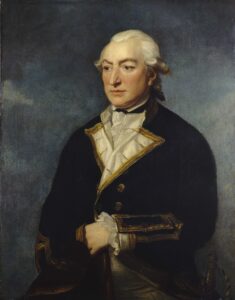
Captain (Sir) Richard Pearson (1731 – 1806) – HMS Serapis
Even though Captain Pearson lost his ship to the enemy, he was considered a hero for his naval skills and spirited defence in saving the convoy.
Pearson came from a respectable Westmoreland family and had an active and successful early career. His defence of a Baltic convoy off Flamborough Head while in command of the 44-gun ‘Serapis’ is what he is best known for. When they were attacked by the American rebel squadron led by John Paul Jones ‘Bonhomme Richard’, the ‘Countess of Scarborough’, was quickly taken by the American ‘Pallas’ and left ‘Serapis’ in a hard fight against superior force. Pearson eventually surrendered to Jones but only after inflicting such damage to the ‘Bonhomme Richard’ that she sank shortly afterwards. Jones took the captured ‘Serapis’ with its prisoners and other vessels to neutral Texel, Netherlands.
On release Pearson was court martialled (as is done to all Royal Navy officers who lose their ship) but then honourably acquitted of the loss of his ship and knighted for his defence and saving the valuable convoy – all of which escaped unscathed. In addition Pearson received other civilian rewards including three coconut cups and “freedoms” of Hull and Scarborough. While it was excessive recognition for an embarrassing defeat sustained in public view from the cliffs of Flamborough and Bempton the knighthood rightly made the point that the Navy’s primary role was the protection of trade as the source of national wealth and security, and that escorts were expendable in comparison. Jones on hearing of it however aptly remarked: ‘Should I have the good fortune to fall in with him again, I shall make a lord of him!’
Pearson became Lt Governor of Greenwich Hospital, at that time a permanent residence for retired sailors of the Royal Navy, before he died in 1806. We are very pleased to declare that Captain Pearson’s great, great, great, great grandson, Sir Sherard Cowper-Coles KCMG LVO, is now our Patron.
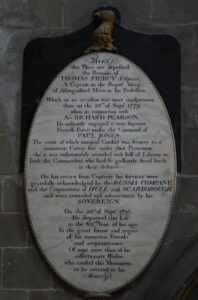
Captain Thomas Piercy (1732 – 1793) – Countess of Scarborough
Not a great deal is known about Captain Piercy apart from his active role in the Battle of Flamborough Head.
Commissioned a lieutenant in 1757 and promoted to commander in 1778, Piercy captained the Royal Navy escort ship “Countess of Scarborough”.
Prior to the engagement of battle, Piercy’s role was to sail with the convoy and ensure that none of the ships became separated while the Serapis raised its sails to get in between the approaching enemy squadron and the fleeing merchant ships. When the convoy was a safe distance away, Serapis signalled for Countess of Scarborough to re-join it and get in position so that the approaching enemy squadron could not sail around them and capture the merchant ships.
During the battle, the Countess of Scarborough exchanged fire with the Alliance before sailing to the aid of the Serapis. But by this time the Serapis and Bonhomme Richard were locked together and Piercy could not fire a broadside without also hitting the Serapis. The Pallas then joined in, sailing towards the Countess of Scarborough, forcing Piercy to slowly retreat and surrender.
Piercy was acquitted of his vessel’s loss at his court-martial on 10 March 1780. As well as receiving high praise for his defence of the convoy, he was rewarded by the Royal Exchange Assurance Company (known today as AXA Insurance), given the “Freedom of Scarborough” and presented with a silver casket which resided with all commissioned “HMS Scarborough” ships until 1971 when the casket was presented to Scarborough Council for safe keeping. It currently resides in Scarborough Town Hall.
Early in 1782, Piercy was commissioned to the Panther 60 at Portsmouth for the Channel Fleet campaign from April-August, but being in poor health he left her when she reached the Downs in June. He died on 22 September 1793 and was interred at Canterbury Cathedral.
His address in his will was given as Canterbury, Kent. He left only a widow.
Piercy was very well liked by his officers and men and was regarded as an excellent officer.
Captain John Paul Jones (1747 – 1792) – Bonhomme Richard 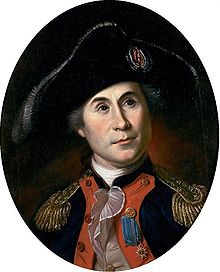
Born in Kirkbean, Scotland Jones was the son of a gardener at Arbigland House and is best-known in the USA as the “Father of the American Navy”, although this declaration did not take place until over 100 years later by then president, Theodore Roosevelt. The original cottage where he lived still stands as the John Paul Jones Cottage Museum.
Prior to the Battle of Flamborough Head Jones commanded the warship “Ranger” and had conducted a naval campaign in the North Sea, attacking British merchant shipping and other civilian targets. As part of the campaign, he raided the English town of Whitehaven on 17 April 1778. The intention was to create a diversion whilst the French and Spanish Navies intended to engage a smaller British fleet and invade!
During the battle it is claimed when asked by Captain Pearson if he surrendered Jones is said to have famously replied, “Surrender? I have not yet begun to fight!”. A quote all American school children learn in their history classes.
The battle lasted for more than three hours and is regarded as bloody and gruesome even in its time. Once Pearson and Piercy had surrendered their escort ships to the Franco-American squadron, most of Bonhomme Richard’s crew transferred to other vessels and the burning ship was allowed to sink. Jones took command of the Serapis and Countess of Scarborough for the trip to Texel in neutral Netherlands.
After the war, Jones was left without a command in the US Navy and in 1787 he joined the Imperial Russian Navy rising to the rank of rear admiral becaming a court favourite of Empress Catherine II. However, it is claimed that commander Prince Grigory Potemkin was jealous of this relationship and some historians claim that Jones was set up and accused of assaulting a 10-year-old girl, Katerina Stepanova. He was forced out of the Russian Navy and fled to Paris where he soon died at the age of 45. He was buried at the Saint Louis Cemetery which belonged to the French royal family. Frenchman Pierrot Francois Simmoneau donated over 460 francs to mummify the body. Jones’s grave was either unmarked, or the marker was stolen and he disappeared from record.
In 1905, Jones’ remains were identified by U.S. Ambassador to France, General Horace Porter, who had searched for six years to track down the body. Jones’s body had been fortuitously preserved in alcohol and interred in a lead coffin “in the event that should the United States decide to claim his remains, they might more easily be identified.” Jones was re-interred at the US Naval Academy in Annapolis, Maryland in 1906 in a grand state cermony.
French Captains
Pierre Landais (1738-1820) of USS Alliance 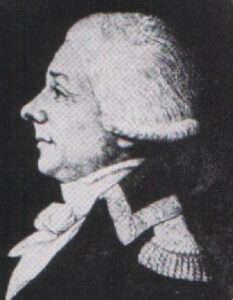
There is an enigma that surrounds Captain Landais. After being made an honorary citizen of Massachusetts, he was given a position in the Continental Navy. He has been described as a deluded, paranoid and arrogant man by his contemporaries. Future US President, John Adams, described him in his diary as “jealous of everything. Jealous of everybody… he knows not how to treat his officers, nor his passengers, nor anybody else.” Prior to, and allegedly during the battle of Flamborough Head, Landais and Jones clashed repeatedly – figuratively and quite literally!
Denis Nicolas Contineau (1745-1808) of Pallas 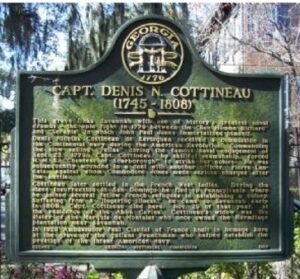
During the Battle of Flamborough Head Captain Contineau forced the Countess of Scarborough to strike her colours and she was captured for the Franco-American squadron. Contineau was subsequently wounded in a duel with Pierre Landais to whom Jones had made serious charges against after the battle. After the war, Contineau settled in the French West Indies before moving to Savannah, Georgia where he died. He is buried in the Colonial Park Cemetery and a plaque was erected in his honour in 1957.
Captain Phillippe Nicolas Ricot of Vengeance
During the battle the Vengeance, being a small ship with only 12 guns, could do nothing but simply stand off. We do not know of what became of Captain Ricot after the battle. If there are any historian sleuths that can tell us more, please let us know!
